Support tickets, every month

400+

The problem I was asked to find the “why” behind.

Ticket subjects are illustrative, written from the findings below.

400+
support tickets a month, the starting point
41
SME interviews across North America and EMEA
3
months, end to end, from training to recommendations
TL;DR

The Challenge

WAVE PTX is powerful, but partners and agents kept hitting usability walls, and support was fielding 400+ tickets a month.

My Role

UX research intern at Motorola Solutions for three months: an end-to-end audit of the subscription lifecycle, from registration to billing support.

What I Did

Went through 12+ trainings to learn the intended path, shadowed partners, ran SME interviews in North America and EMEA, and benchmarked WAVE against Microsoft Azure and AWS.

What I Found

Partners were stuck in manual mode: tracking licenses by hand, juggling tools, and unable to see what they owned. I recommended automation, one dashboard, and proactive notices.

01 – The Mission

Rescuing the partner experience.

WAVE PTX is a broadband communication service from Motorola Solutions that keeps teams connected across devices. Despite its technical power, partners and agents kept running into usability issues, and the support queue showed it.

The product

A subscription platform partners use to buy, assign and manage WAVE PTX licenses for their customers.

The symptom

400+ support tickets every month, many of them about billing and licenses.

My job

Find the “why” behind the tickets, across the whole subscription lifecycle, and recommend what to fix first.

02 – The Research

Learn the intended path. Then watch people leave it.

A three-month deep dive with teams from the US to Europe and India.

  • 12+training courses & videos
  • 3on-site partner shadowing sessions & interviews
  • 26SME interviews, North America
  • 15SME interviews, EMEA
  • 9WAVE Admin app design validations
01

Become a power user

I completed 12+ training modules on the platform’s architecture. I needed to know the intended path before I could understand why users were straying from it.

02

Shadow and interview

I assisted and led interviews with teams in North America and EMEA, and shadowed partners on site. They were using modern software, with analog workarounds.

03

Benchmark the leaders

I mapped the six stages of the subscription lifecycle and compared each one with Microsoft Azure and AWS.

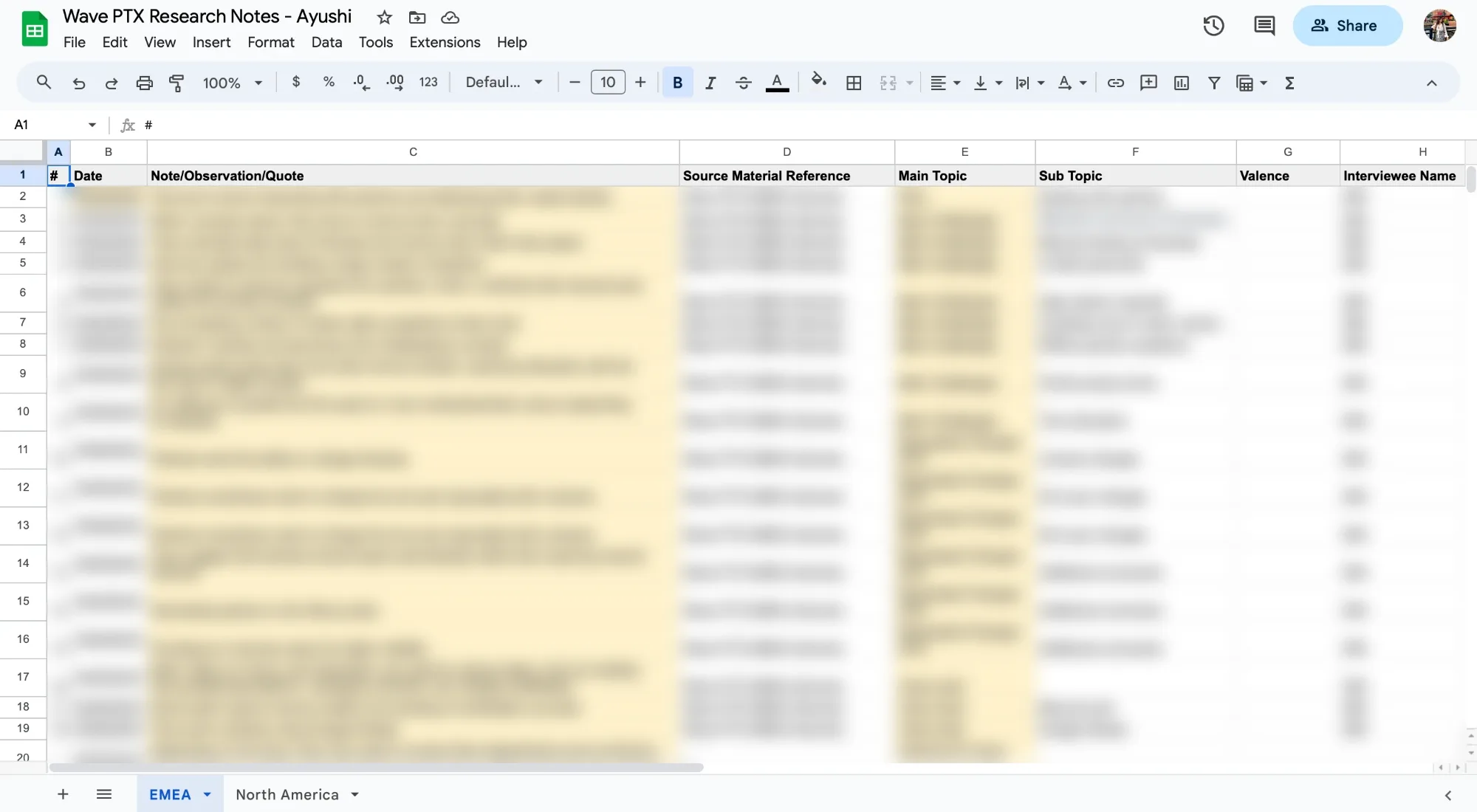
My Wave PTX research notes spreadsheet: columns for date, observation or quote, source, main topic, sub topic, valence and interviewee, with every entry blurredBlurred · the details stay with Motorola
My research notes: every observation tagged by source, topic, sub topic and valence, on separate tabs for EMEA and North America.

The subscription lifecycle · tap a stage

Six stages, mapped end to end.

Registration. Signing up and getting an account. For each stage I walked the WAVE flow, then the same stage in Microsoft Azure and AWS.

From hours of interviews · filter by severity

A severity-coded map, so stakeholders knew what to fix first.

  • 1Moving devices by handMoving 25 devices between accounts meant typing every serial and IMEI number again.
  • 1No view across accountsNo summary pool of licenses: hard to see what’s owned, by type or by customer.
  • 2Billing tickets400+ billing-related support tickets a month.
  • 3Too many toolsOne order lives across several systems.

A short version of the map, in my own words.

03 – What I Found

Partners were stuck in manual mode.

Three findings, each one something you can try.

FINDING 01

MANUAL TRACKING

The spreadsheet trap.

Partners tracked complex contracts in Google Sheets because the portal didn't give them enough visibility. Licenses had to be removed by hand when they expired. And moving devices between accounts meant retyping every number.

Try it · move a device to another account

A partner moves 25 devices from Account X to Account Y.

Device 1 of 25

Serial
SN-525Z6589
IMEI
350921903006987

0/15 digits

Serials and IMEIs here are made up. The real portal isn’t shown.

Decision log

What I saw
To move 25 devices from one account to another, a partner had to gather every serial and IMEI number and type them in by hand.
Why it matters
Every manual step is a chance for a typo, and every typo is a support ticket.
FINDING 02

FRAGMENTED TOOLS

One order, several systems.

To manage a single order, people juggled MOL, OCC and Greenfield, plus their own spreadsheets.

Try it · open every tab

Managing a single order meant juggling tools.

Motorola Online

Where partners place orders.

0 switches so far. Keep going.

Decision log

What I saw
No single place held the whole order, so every question started with “which tool?”
Why it matters
Each hand-off between systems is where context gets lost and calls to support begin.
FINDING 03

INFORMATION BLINDNESS

No summary pool of licenses.

There was no single view of available licenses, so it was hard to see what a partner owned, by type or by customer.

Try it · how many licenses does this partner own?

No summary pool. Just one account at a time.

0 of 6 accounts opened. Now add them up in your head.

Accounts and numbers are made up, to show the shape of the problem.

Decision log

What I saw
Partners had to look account by account to answer a basic question: what do we own?
Why it matters
If partners can’t see it, they ask support. Visibility is ticket deflection.

04 – Competitive Benchmarking

Users didn't need flair. They needed utility.

Azure and AWS offered automated license tracking, dashboards and clear, grouped invoicing. Our users needed the same information-dense utility.

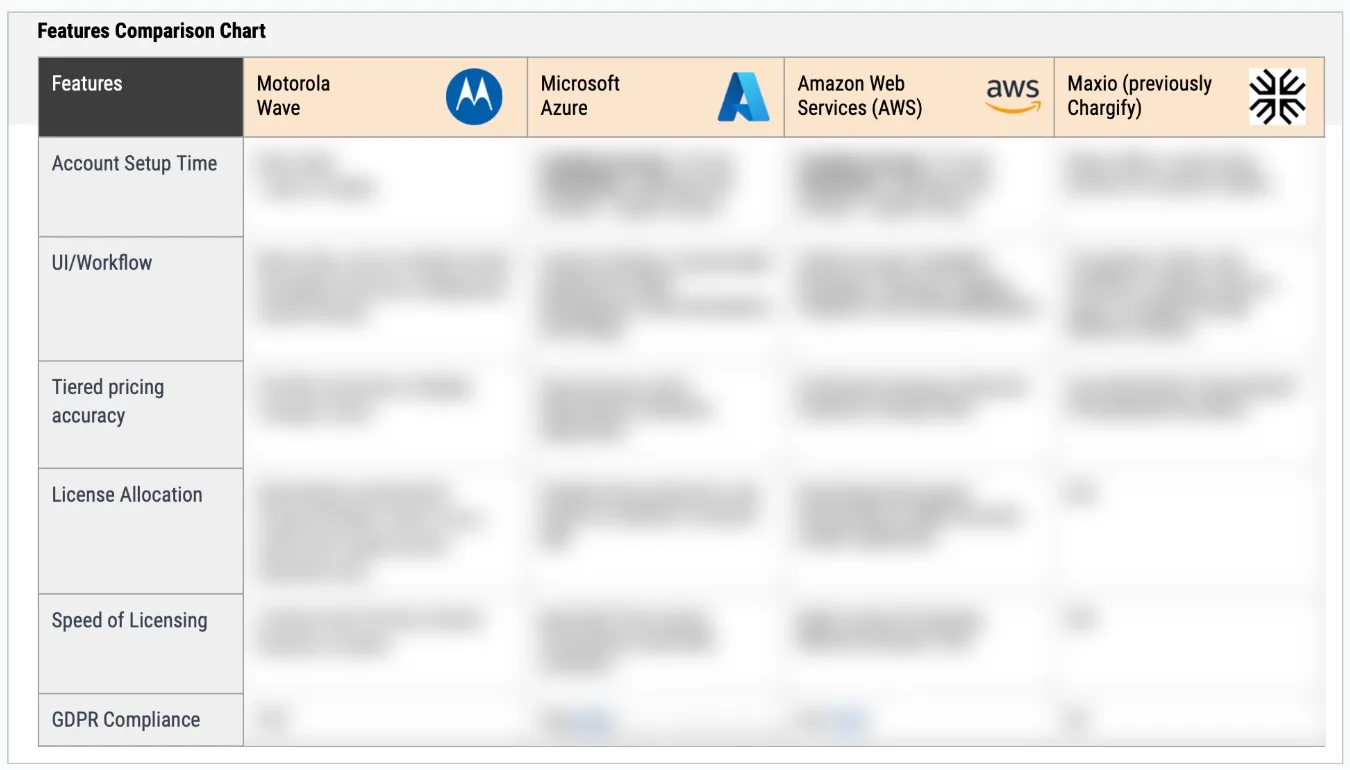
Features comparison chart of Motorola Wave, Microsoft Azure, AWS and Maxio across account setup time, UI and workflow, tiered pricing accuracy, license allocation, speed of licensing and GDPR compliance, with the findings blurredBlurred · the details stay with Motorola
Setup, workflow, pricing, allocation, licensing speed, GDPR.
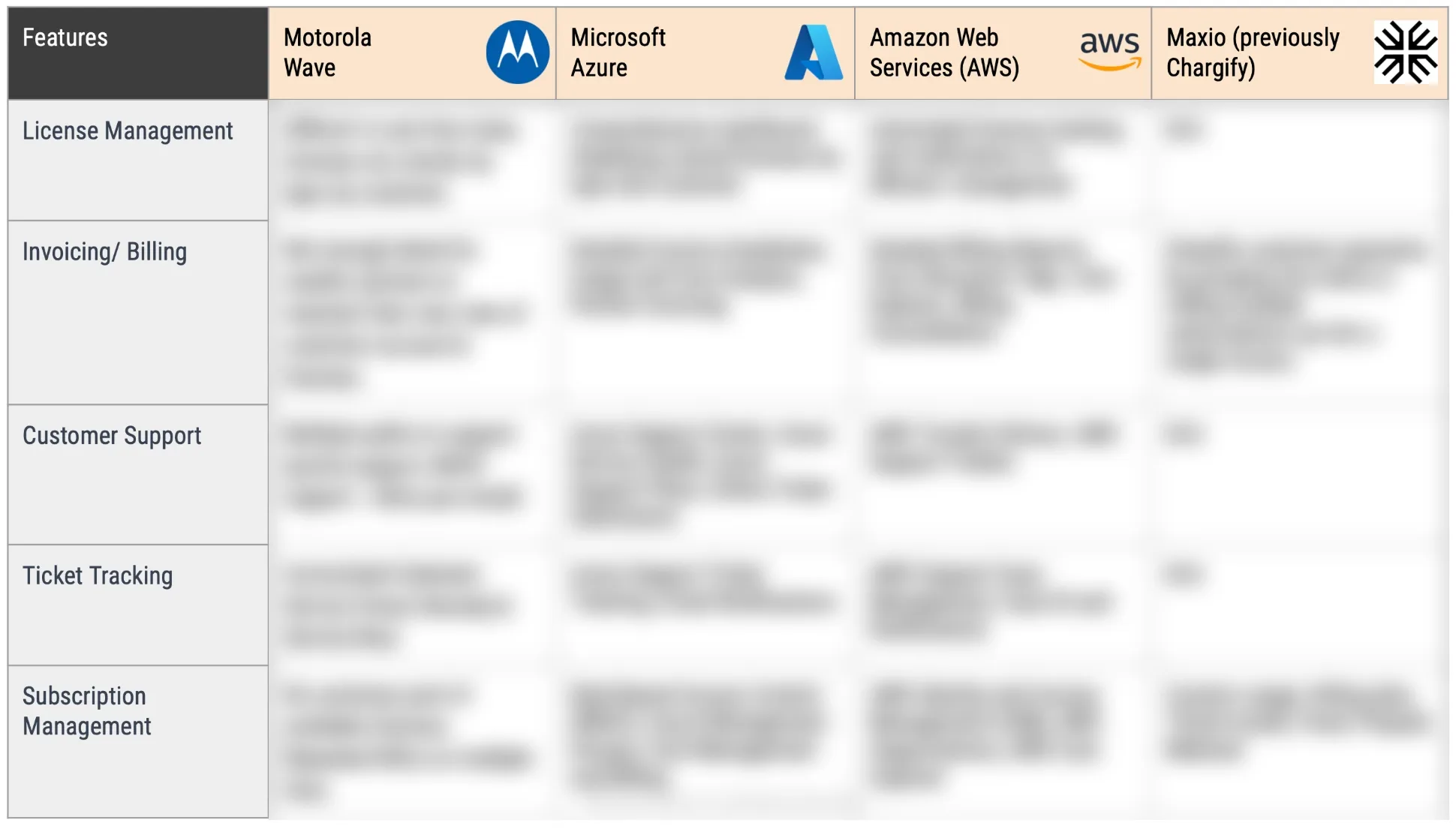
Comparison of Motorola Wave, Microsoft Azure, AWS and Maxio across license management, invoicing and billing, customer support, ticket tracking and subscription management, with the findings blurredBlurred · the details stay with Motorola
Licenses, invoicing, support, tickets, subscriptions.

The real benchmark: WAVE against Microsoft Azure, AWS and Maxio across eleven features.

Competitive benchmark · flip the comparison

How the industry leaders handle information density.

WAVE PTX
License trackingKept by hand, often in spreadsheets
Seeing what you ownNo summary pool of available licenses
InvoicesBilling questions end up as support tickets

05 – The Strategy

From friction to flow.

I presented the findings to stakeholders with three recommendations, each mirroring industry best practice. Flip each one from today to proposed.

01

Automated lifecycle

  1. License expires
  2. Partner has to notice
  3. Removes it by hand

Licenses expire on their own, so nobody has to track and remove them.

02

Unified dashboard

  1. Check MOL
  2. Check Partner Hub
  3. Check the spreadsheet
  4. Ask support

Modelled on Azure: 24/7 self-help resources and a clear billing history in one place.

03

Proactive communication

  1. Invoice changes
  2. Partner is surprised
  3. Support ticket

Automated notices about upcoming invoices and billing changes, to cut the “mystery” support calls.

06 – Impact & Takeaway

Not fixing a website. Restructuring a workflow.

The research gave Motorola a prioritised picture of where partners were losing time, and a path toward:

  • Deflecting support tickets, by letting partners see and do more themselves.
  • Giving partners the control AWS and Azure already offer.
  • Scaling, so that as the platform grows, the support team doesn't have to.

Outcomes

Measured

This was a research project: the deliverable was the findings and recommendations.

  • not measured hereMonthly support tickets, against the 400+ baseline

How I’d measure it

  • Ticket volumeMonthly billing and license tickets, before and after each change.
  • Time on taskTime to move devices between accounts, or to find what a partner owns.
  • Self-serve rateShare of questions answered in the dashboard without contacting support.

Enterprise users don't need flair. They need to see what they own.